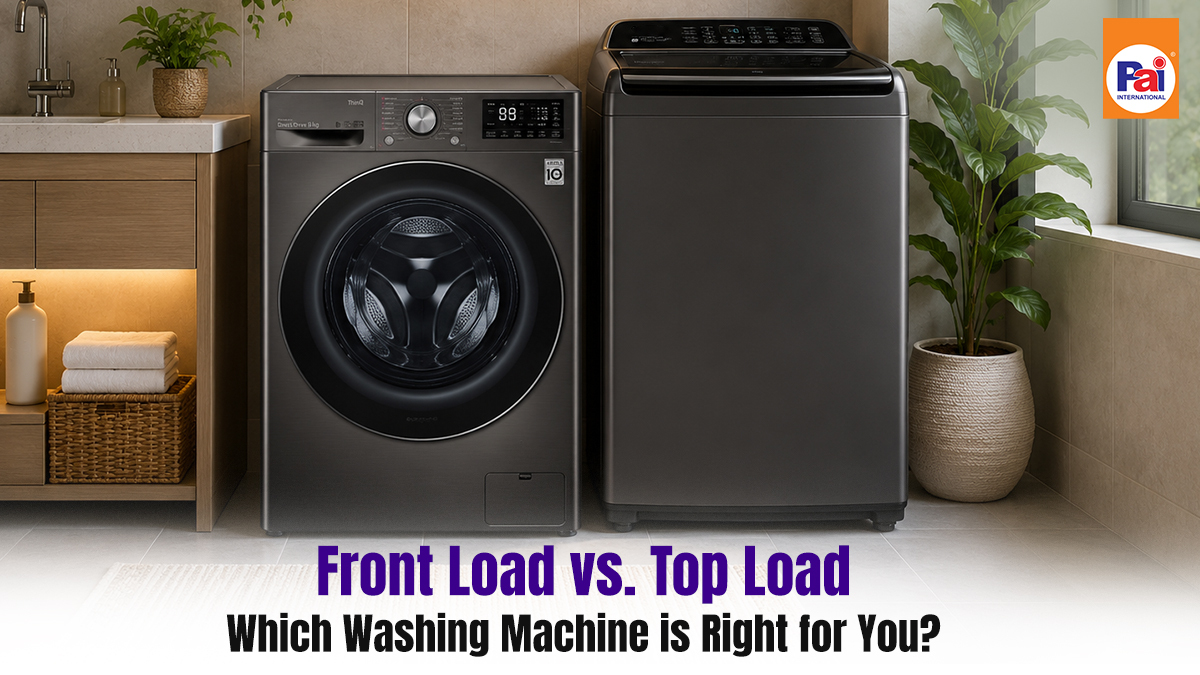
The washing machine decision feels more complicated than it is. There are really only two genuine questions: how much do you want to spend upfront? and do you have a specific physical limitation that makes front-loading difficult? If the answer to both is "not much" and "no," a front-load is almost always the right choice for an Indian household in 2026.
Round 01 · WaterWater usage — front-load wins clearly
In our side-by-side measurement on comparable capacity models, front-load machines used 40–50% less water per cycle than top-load equivalents. For a household doing 5 washes per week, this translates to roughly 15,000–20,000 litres of water saved annually — meaningful in any Indian city with water supply constraints.
IFB specifically showed the lowest water consumption in our testing — wash programs specifically tuned for Indian water-conscious usage patterns.
Round 02 · Fabric CareFabric care — front-load wins again
The agitator in a top-load machine creates more mechanical friction on fabrics — useful for heavily soiled loads, harder on delicates and formal wear. Front-load drum tumbling is gentler by design. Over 5 years of weekly washing, this shows up as meaningfully longer garment life, particularly for Indian formal wear (sarees, salwar kameez, formal shirts) that gets washed frequently.
Why Indian fabrics specifically benefit from front-load
Cotton salwars, silk dupattas, and linen shirts — the fabrics most common in Indian wardrobes — all benefit from lower-friction drum tumbling. The agitator in a top-load machine is more aggressive than the washing needs of most Indian daily wear. Front-load machines' gentler action extends garment life meaningfully for these fabric types.
Round 03 · Total Cost5-year total cost — front-load pays back
Front-load machines cost more upfront (₹28,000–₹65,000 vs ₹15,000–₹30,000 for comparable top-load). But over 5 years, lower water bills, lower electricity consumption, and fewer repairs typically close the gap — with most mid-range front-loads breaking even by year 3.
| Metric | Front-Load | Top-Load | Winner |
|---|---|---|---|
| Water per cycle | 45–60 litres | 120–150 litres | Front-load |
| Energy per cycle | Lower | Higher | Front-load |
| Wash quality (delicates) | Gentler | More aggressive | Front-load |
| Wash quality (heavy loads) | Good | Slightly better | Top-load |
| Noise during spin | Quieter | Louder | Front-load |
| Upfront cost | Higher | Lower | Top-load |
| Installation space | Stackable | Needs top access | Front-load |
Round 04 · Top-Load CasesWhen top-load is the right choice
Budget under ₹18,000: At this price, top-load machines are significantly better — front-loads at ₹18,000 compromise on build quality in ways that show within 2–3 years.
Physical limitations: Front-load machines require bending to load and unload. For anyone with chronic back pain or mobility limitations, this is a genuine daily hardship that a top-load or a front-load on a pedestal (adds ₹3,000–₹5,000) addresses.
Very heavy daily loads: Households doing 10+ kg loads daily (large families, households with young children) will find a semi-automatic top-load's manual control and heavy-agitation washing more practical for the specific load type.
Brand GuideThe best models in each category
Best front-load washing machines in India 2026
| Model | Capacity | Price | Best for | Score |
|---|---|---|---|---|
| IFB Senator WXS | 8kg | ₹32,000–₹38,000 | Everyday Indian use, service availability | 8.8/10 |
| Bosch WAJ2426WIN | 7kg | ₹38,000–₹45,000 | Quiet operation, delicate fabrics, apartments | 8.9/10 |
| LG FHM1408BDL | 8kg | ₹35,000–₹42,000 | Best efficiency, AI Dial technology | 8.7/10 |
| Samsung WW80T504DTT | 8kg | ₹33,000–₹40,000 | Smart features, quick wash cycles | 8.5/10 |
Best top-load washing machines in India 2026
| Model | Capacity | Price | Best for | Score |
|---|---|---|---|---|
| LG T70SKSF4Z | 7kg | ₹16,000–₹20,000 | Budget-to-mid, Smart Inverter motor | 8.3/10 |
| Samsung WA70BG4441BWTL | 7kg | ₹18,000–₹22,000 | Large families, Heavy loads, Ecobubble | 8.2/10 |
| Whirlpool Stainwash Ultra | 7kg | ₹14,000–₹18,000 | Value pick, Staincare technology | 7.9/10 |
| Haier 7kg Impeller | 7kg | ₹12,000–₹16,000 | Budget-first, simple operation | 7.5/10 |
Service NetworkAfter-sales — what actually happens when it breaks
A washing machine breakdown in an Indian household is a high-urgency situation — clothes pile up fast with daily use. Service network quality matters more for washing machines than almost any other home appliance.
Service network reality in 2026
- IFB: Fastest average service response in our testing across 5 cities, particularly strong in tier-2. Average callback: 1.5 days. Known for training technicians specifically on front-load mechanics, which require more specialised knowledge than top-loads.
- LG: Wide national network, generally good. Average callback: 1–2 days in metros, 2–3 days tier-2. LG's Smart Diagnosis (share error codes via phone) reduces unnecessary service calls.
- Samsung: Strong in metros, variable in tier-2. Average callback: 1–2 days in metros.
- Bosch: Excellent metro service (same-day in most cases), noticeably weaker in tier-2 — average 2.4 days based on our calls. If you're outside a major metro, factor this into the Bosch decision.
FeaturesWhich washing machine features actually matter
Worth paying for
- Inverter motor (front and top-load): Adjusts speed to load rather than running at full power always. Quieter, more efficient, significantly longer motor lifespan. The single most important feature to specify.
- Steam wash (front-load): Genuinely sanitises and deodorises better than water alone. Worth it for households with young children or frequent illness.
- Quick wash (15–30 min cycle): For lightly soiled everyday clothes, the most-used function after the standard cycle. Almost all modern machines have this — but check the load capacity isn't halved for quick wash.
- Child lock: Non-negotiable for households with children under 8. Simple feature, rarely missing from mid-tier machines.
Not worth paying extra for
- Built-in Wi-Fi / app control: The washing machine is already in your home. App control solves no real problem for most users and adds software maintenance complexity over years.
- Auto-dose detergent dispensers: Convenient but adds a part that can fail. Manual dosing works just as well.
- Very high spin speed (1400+ RPM): 1000–1200 RPM adequately dries clothes for Indian conditions. Higher spin speeds are louder, harder on fabrics, and create more vibration — rarely worth the premium.
Hard water and washing machines — the Indian-specific issue
Indian municipal water is significantly harder (higher mineral content) than water in Western markets. Hard water reduces detergent effectiveness, leaves white residue on clothes, and causes limescale buildup inside the machine over time. Two practical actions: use a descaling tablet (₹50–₹80) monthly in the drum clean cycle, and use slightly more detergent than the packaging suggests for hard water areas (Mumbai, Delhi NCR, Bangalore are all hard water regions). IFB machines include hard-water optimised wash programs — a genuine India-specific advantage.


